British Equestrian Level 4 Coaching Certificates awarded at London International Horse Show
Friday 19 December 2025
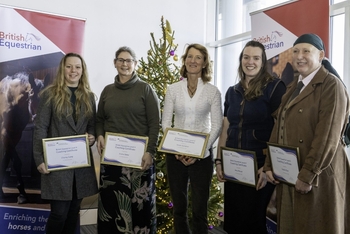
Today, five outstanding coaches have been awarded their British Equestrian Level 4 Coaching Certificate, endorsed by UKCC, following completion of their final panel assessments. The ceremony took place as part of a British Equestrian-organised event at the London International Horse Show, with certificates presented by the federation’s Chief Executive, Jim Eyre.
This year, the coaches came from a range of equestrian organisations and disciplines:
- Amy Blount – British Dressage
- Charley Camp – The British Horse Society
- Sarah Gairdner – British Eventing
- Emma Slater – British Showjumping
- Sophie Starr – The British Horse Society
Amy Blount is a dressage coach from Hampshire, who’s research examined what governing bodies consider to be high-performance coaching in different equestrian disciplines.
“I did a language analysis of the Level 3 Coaching syllabuses of the three Olympic disciplines, and looked at what types of knowledge they were valuing, promoting and developing,” explained Amy.
“It was really interesting because it brought up quite a lot about how they’re structured, what language is used and how the world is moving on – how we look at the coach, horse and rider triad, rather than just the rider and the horse. In our job, in our sport, we’re very different because we have a second athlete to think about, and it’s therefore the knowledge we have can’t just be technical because how we communicate that to the rider impacts how they communicate it to their horses.”
Based in Dorset, Charley Camp applied for the Level 4 Coaching programme just months after a life-changing accident, which inspired her to explore the support available to coaches who have witnessed accidents or sporting injuries as part of her research project.
“About two years ago, I had quite a gnarly accident and that’s actually how I came to be here today – if I hadn’t had my accident, I wouldn’t have gone to the open day and if I hadn’t come onto the programme, I wouldn't have the job that I have now because I wouldn’t have met the people that I’ve got to know,” said Charley
“Part of what influenced my research is that the coach on the ground who witnessed by accident can’t remember anything. I wanted to know how that impacted her and how it affects her life. If we don’t start looking at coach welfare and how they can be the best versions of themselves, how can we expect them to coach at the highest level and have that influence on the rider and horse?”
Sarah Gardiner is an evening coach from Oxfordshire took a slightly different approach to her research project by exploring heart rate changes in amateur riders and horses before entering the dressage arena and potential implications for coaching strategies to manage stress.
“Being on the programme has changed me from just being very busy to actually being very constructive in what I do. It’s changed the way I run the yard and I’m putting more coaching programmes together, rather than just doing ad-hoc stuff,” commented Sarah.
“During my research, I spent a lot of time talking to people about what they’re doing in the warm-up – a lot of competitions are lost in the warm-up. I actually had a horse that was very tricky in the dressage and my mother turned round and said that she bet I wished I’d done this when I still had her – it hadn’t even crossed my mind, but I can look back and think that maybe this would have been quite powerful. I’m now moving it into the showjumping arena and warm-up and looking at what amateurs do there.”
A showjumping coach from Gloucestershire, Emma Slater chose to focus her research on experience versus expertise and whether riders value one over the other when choose a coach.
“When you’re coaching, you really want your riders to be empowered and have life-long learning, not just do well in the lesson and have it all go to pot straight afterwards. I want my riders be able to build on what they’d learned in the lesson and go on to train themselves and their horses to go better,” said Emma.
“Being on the course helped me to really stand back and think about my values and philosophy as a rider – I’ve also been very horse-centred and have a real relationship with my horse, and that’s what I’m trying to coach. However, until you have that chance to stand back and critically reflect on your own coaching practices and how you’re communicating that to your riders helped me to understand their perspective. That has really impacted my coaching and made me a more effective coach, which gives me great pleasure.”
Sophie Starr is based at Bryanston School in Dorset. Her research looked at how feedback impacts candidates in practical coaching assessments, with the aim of supporting coach retention and development within the industry.
“I wanted to look at the development of the young people that we’re teaching – they’re changing and their expectations for us are higher, so it’s for us to make ourselves reach those expectations, rather than do what we’ve always done. We’ve got to move with the expectations of our young riders,” explained Sophie.
“My piece of research was about feedback from the perspective of the candidate. Going forward, I’m going to look at feedback from the perspective of the assessors and how it’s impacted them.”
The Level 4 Coaching course is run in conjunction with British Rowing and the University of Gloucestershire. Its advanced academic syllabus is designed to help high-performing coaches to develop their skills by building on vision and knowledgeable decision-making, while displaying exceptional behaviours and the highest professional and ethical standards.
“It’s a huge privilege to be able to celebrate with these coaches and see them receive their Level 4 certificates,” said David Padgen, who oversees the Level 4 Coaching Certificate programme as part of his role of Relationships Officer at British Equestrian. “To be there at the beginning of their two-year programme and witness the progression of each coach as they learn new theories and applying them to their practice is wonderful to witness. Massive congratulations to them all.
“Running such a successful programme wouldn’t be possible without the committed coach developers we are honoured to use – Nicky Fuller, Colin Wilson, Dr Jane Booth and Jenny Coe – and the academic team at the University of Gloucestershire, led by Dr Rachel Bullingham. This is particularly the case this year because our partnership with the University of Gloucestershire is drawing to an end with this graduating group. Thank you to all those that make today’s celebrations possible.”
Further information about the Level 4 Coaching Certificate is available here.
Image: British Equestrian / Jon Stroud Media


